
It is unsettling to find an EV that will not unlock even though its traction battery had plenty of charge the day before. The same can happen with a hybrid. When the car appears completely asleep, the first number to think about is not remaining driving range. It is the 12V low-voltage system that wakes the doors, displays, and control units.
Articles about EV 12V batteries and protection features appeared again in October 2026. Still, a silent car is not a reason to connect a jump pack immediately. First separate a weak key-fob battery from a low vehicle 12V system and from a drivetrain or charging-system warning. This guide is based on manufacturer manuals and battery inspection material checked on October 17.
Different roles for the traction battery and 12V system
The traction battery supplies the large amount of energy needed to move the car. The low-voltage system powers locks, control units, and the cluster, and it helps the vehicle transition into a drive-ready state. An EV can therefore show usable traction-battery charge and still fail to unlock, illuminate the cabin, or enter READY when its 12V supply is too weak.
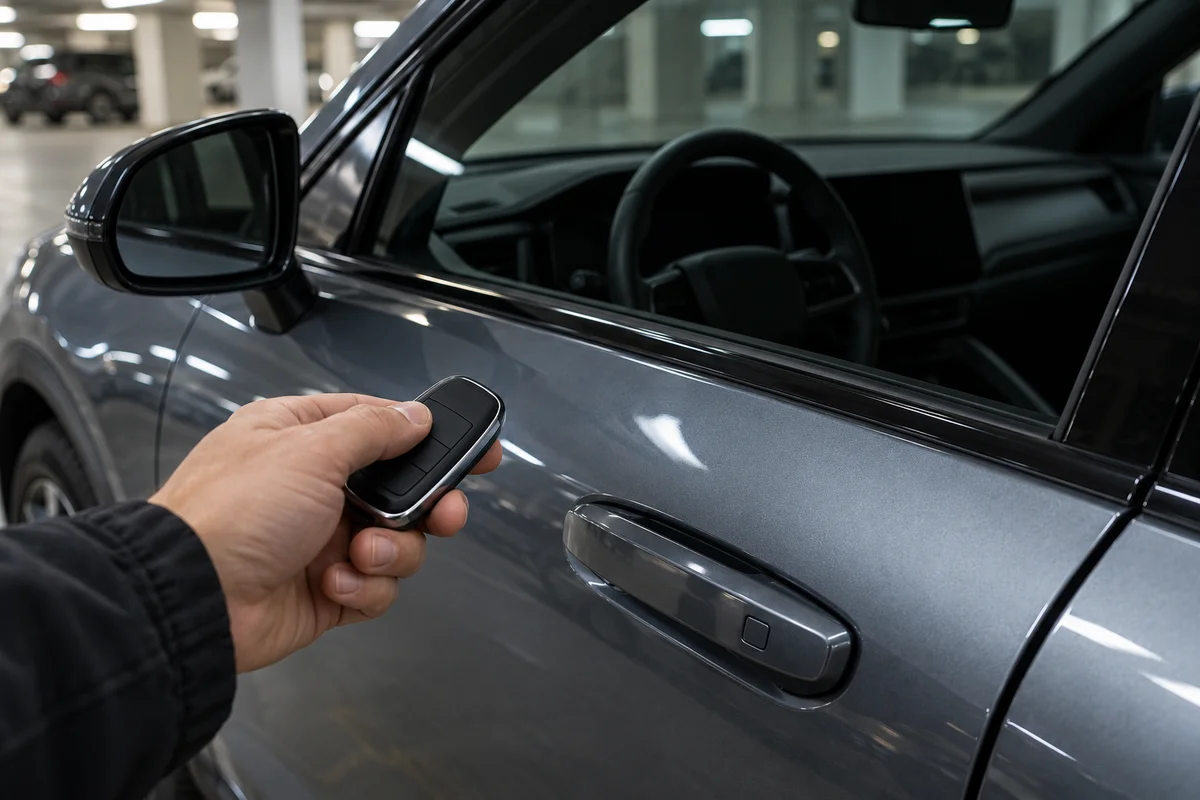
Is it one key, or is the entire car asleep?
| What you see | First area to consider | Next action |
|---|---|---|
| A spare key works but one key does not | The key-fob battery or that key | Check the spare key and the mechanical-key instructions |
| Cabin lights, hazards, and the cluster are all weak or dark | The vehicle's 12V low-voltage system | Find the 12V reset or emergency-starting section in the manual |
| The cluster lights up and shows a traction-battery or charging-system warning | Possibly more than a simple 12V discharge | Stop improvised jump attempts and request assistance that matches the warning |
This is an observation aid, not a diagnostic chart. A door that will not unlock does not by itself prove a discharged 12V battery, and emergency entry differs by model. Check the spare key and the cabin or cluster response, then follow the vehicle manual's mechanical-key procedure.
Read the manual before reaching for jumper cables
Some Kia hybrids have a 12V BATT RESET button. On vehicles equipped with it, the manual may direct the driver to reconnect the isolated low-voltage supply with the button before using an external power source. Button location and the allowed time to start the car vary. Do not copy a location or sequence from another model or an online video.
Search the manual for “12V battery,” “emergency starting,” and “jump start.” Confirm the battery or designated positive-terminal location, the grounding point, and whether a reset feature exists. Orange high-voltage cables and the traction battery are not jump-start or disassembly points for a driver.
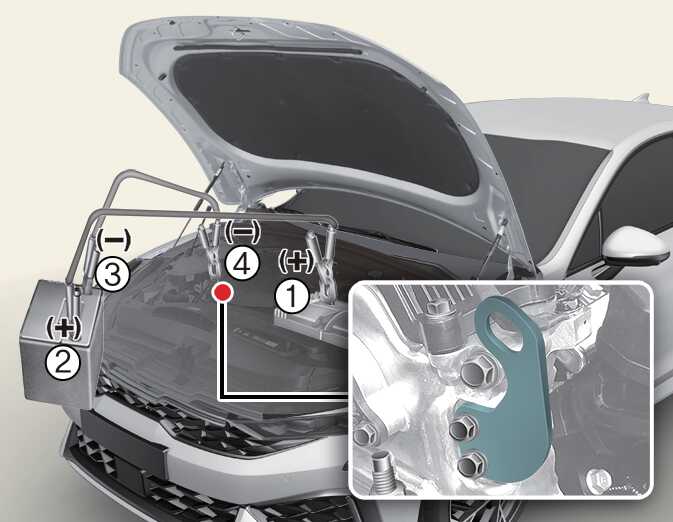 Kia Owner’s Manual
Stop if any of these warning signs appear
Do not connect a jump pack in these situations. If the car is stopped on a road, switch on the hazards, move to a safe place when possible, and request roadside or manufacturer assistance. Move away and call emergency services if there is smoke or fire. Do not lean over the battery to investigate.
If the manual permits a 12V jump
Kia's 2026 manual specifies a 12V source, with unnecessary electrical loads switched off and cables connected in the prescribed order. Some vehicles require the booster negative lead to go to a solid ground point away from the discharged battery rather than directly to its negative terminal. The useful skill is not memorizing one universal sequence; it is finding the terminals and grounding point assigned to your car.
Do not select a portable jump pack by the 12V label alone. Confirm that the vehicle manual permits jumping, and that the device supports the low-voltage battery type and starting demand of the vehicle. Check polarity and overcurrent protection, cable and clamp condition, storage temperature, and the manufacturer's recharge interval.
A successful start does not explain the discharge
 Wikimedia Commons
A jump start only wakes the vehicle temporarily. The cause still needs attention. Review parking-mode dashcam use, how long the car sat, lights or accessories left powered, battery condition, and the charging system. Instead of deciding on replacement from one voltage reading, ask a workshop to check CCA, state of charge, and parasitic draw when needed. Repeated symptoms call for an inspection, not simply a longer drive.
Before a long parking period, review the low-voltage cutoff for parking recording and any added electrical equipment. Enable a 12V status notification if the vehicle app provides one. A protection feature, however, cannot guarantee against an aged battery or abnormal current draw. That is why a check before colder weather is worthwhile.
Choose emergency equipment for two separate jobs
If a disabled car is on a dark road or shoulder, visibility to approaching traffic comes before restarting it. Look for a warning triangle that fits in the trunk, reflects light during the day, provides illumination at night, and makes stored-battery condition easy to inspect.
A jump pack is the second tool. It suits a driver who has confirmed that the manual permits 12V emergency starting and has located the correct terminal and ground point. Check supported vehicle range, protection circuits, cable and clamp condition, and charge status. If the procedure is unfamiliar, save the roadside-assistance number as well.
Three checks to make today
Before temperatures fall further, it is also worth checking winter markings and wear on the tires. If you are choosing a hybrid, look beyond fuel-economy figures and read how the manual describes emergency starting and a possible 12V reset.
A silent car does not automatically mean a major failure, but a jump pack is not always the answer. Observe the key and cabin response, find the instructions for your exact vehicle, and proceed only when no danger sign is present. Those three steps prevent many unnecessary and unsafe attempts.
Sources reviewed
The article was checked against the sources below. Image context and credits appear in each caption.
- Tech Translator, EV 12V Battery Saver Operating Conditions and Limits (Oct. 15, 2026)
- Kia 2026 Hybrid Owner's Manual, Before jump starting — 12V Battery Reset
- Kia 2026 Owner's Manual, Jump starting
1 more sources
This article contains affiliate links, and the publisher may receive a commission from qualifying purchases.