
According to an October 12 report by Maeil Business Newspaper, SOXL was the most heavily net-bought overseas security among Korean investors from October 5 through 9. Net settlement purchases reached $393.92 million, more than three times the $115.79 million recorded by second-place SGOV, a U.S. Treasury bill ETF. The promise of tripling a semiconductor rise sounds powerful, but the account result can differ sharply from expectations if an investor misses the period to which that ‘3x’ applies.
SOXL is the Direxion Daily Semiconductor Bull 3X ETF. Its stated objective is 300% of the NYSE Semiconductor Index’s return for one day, before fees and expenses. It does not promise three times the return over a week or a month. That is why a bullish view on the semiconductor cycle alone cannot predict the result over an investor’s holding period.
Read ‘daily’ before ‘3x’
Direxion’s official product page labels the objective ‘Daily +300%.’ It also says investors should not expect three times the benchmark’s cumulative return for periods longer than one day. Reading 3X while overlooking Daily leaves out half of the product’s structure.
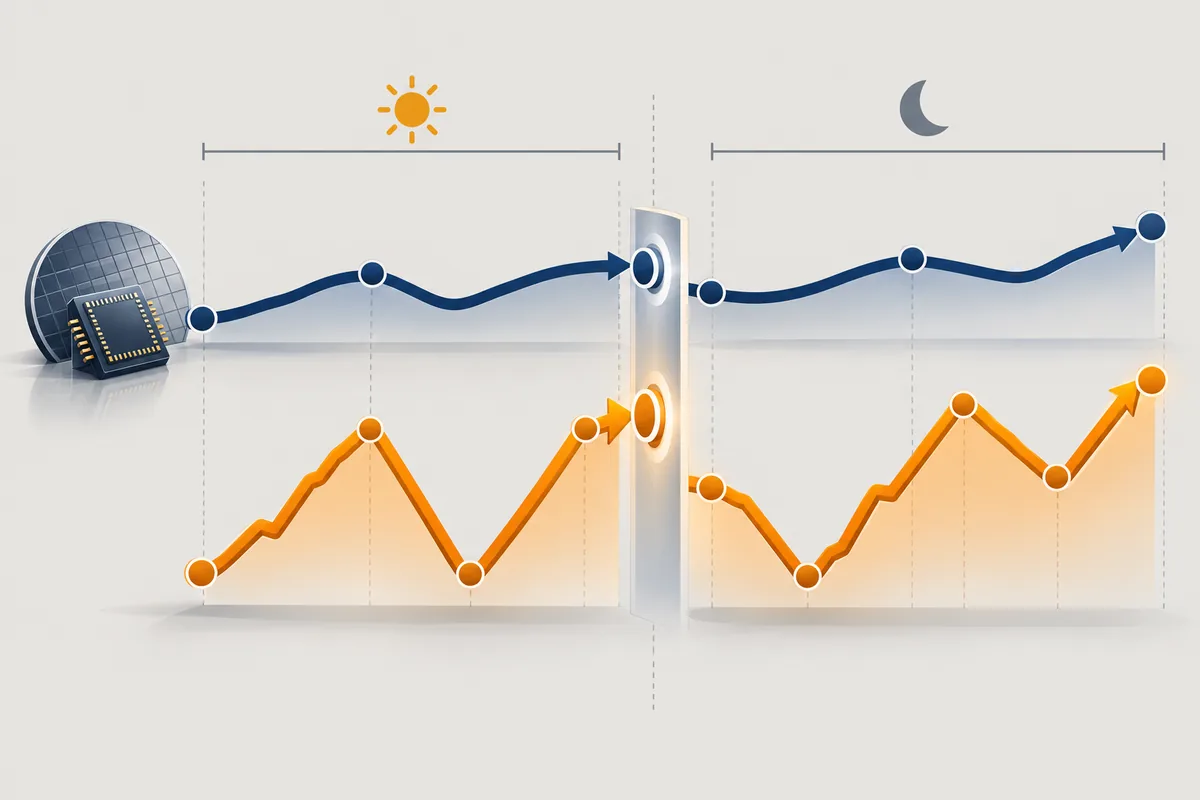
A leveraged ETF uses derivatives such as swaps and futures to reset its target exposure every trading day. The portfolio is adjusted so that it can again seek three times that day’s move in the underlying index. Multi-day returns therefore are not a simple sum of daily returns. Each new percentage move is applied to a balance that has already changed.
SOXL’s 3x is a target reset each trading day, not a promise for the entire holding period.
The index can return to its starting point while the account does not
Suppose an index rises 10% on the first day, moving from 100 to 110, and falls 9.09% the next day, returning to 100. Now assume a product tracks three times each daily move perfectly. It rises 30% to 130 on day one, then falls 27.27% to 94.5 on day two. Even before fees and tracking difference, the two-day return is negative 5.5%.
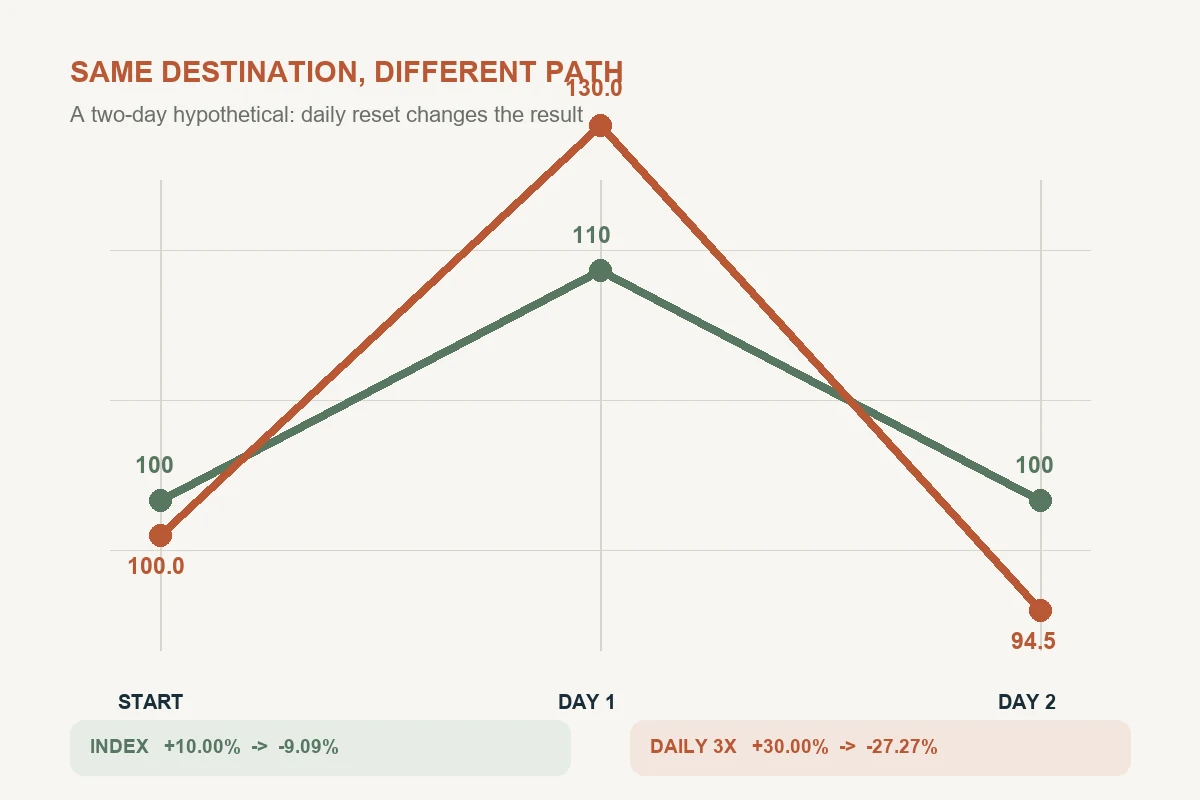
It is also inaccurate to describe this as an inevitable decay. In a sustained one-way trend, compounding can produce a return greater than three times the index’s return over the same period. When gains and losses alternate frequently, volatility can erode performance. The path to the final index level matters alongside the final level itself.
Getting semiconductors right is not enough; timing and path matter too
The benchmark itself is concentrated in one industry. Even when the broad cycle view is right, earnings releases, export controls, interest rates and sharp moves in large constituents can enlarge daily swings. SOXL seeks to magnify those moves threefold on a daily basis. A long-term view of the industry and the short-term path of a leveraged position are not guaranteed to move together.
Currency and costs sit on top of the dollar return
For a Korean investor, both the dollar price of the asset and the won-dollar exchange rate affect the account. SOXL can rise in dollars while a stronger won reduces the return translated into Korean currency; the reverse is also possible. Foreign-exchange spreads and brokerage fees affect the realized result as well. Direxion’s official page listed SOXL’s net expense ratio at 0.75% and gross expense ratio at 0.91% as of October 12.

Write down four things before pressing buy
It helps to put personal constraints into numbers before writing down a semiconductor forecast. Decide whether you can explain why a daily-target product will be held for several days, how much loss you can absorb, whether the position will cross an earnings or policy event, and how returns will be measured after currency and costs. If those four fields are blank, a bullish outlook does not amount to understanding the product.
The SEC’s bulletin on leveraged and inverse ETFs likewise explains that most reset daily and can perform very differently from a stated multiple of the underlying index over periods longer than one day. It warns that the divergence can be amplified in volatile markets and that these products generally are not suitable for buy-and-hold investors.
When looking at SOXL, the first word to read is Daily rather than 3X. The long-term outlook for the semiconductor industry and the return path of a product held from today are separate questions. Keeping them separate makes it easier to look past a high net-purchase ranking or a brief rally and ask whether the account can actually absorb the volatility.
Sources reviewed
The article was checked against the sources below. Image context and credits appear in each caption.