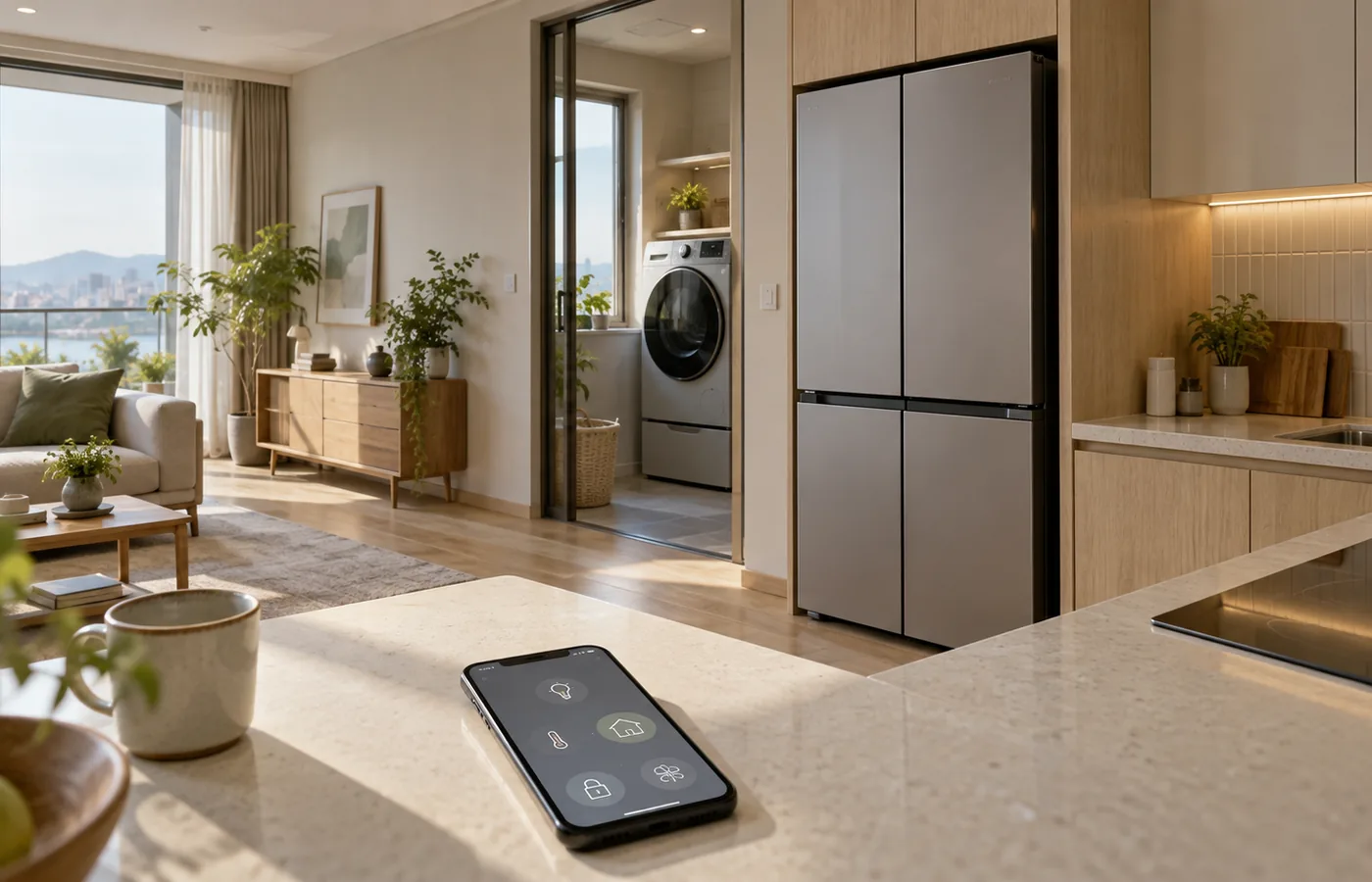
A refrigerator recognizes food while a washer-dryer chooses a cycle based on the load. The AI label is easy to find on this year's appliances. Buying one raises different questions: how often the feature will be used at home, whether it works without the internet or a manufacturer account, and whether it will still be available years from now. Those conditions can matter longer than the price tag.
KES 2026 runs at COEX in Seoul from October 13 to 16 with 500 companies and 1,100 booths. The official KES 2026 information lists AI appliances, on-device AI, and AI security and privacy among its main fields. Samsung and LG are also highlighting refrigerators, washer-dryers, connected homes and appliance subscriptions. A feature that stands out at an exhibition still needs to fit the conditions of a real home.
 Samsung Newsroom Korea
AI does different jobs in a refrigerator and a washer-dryer
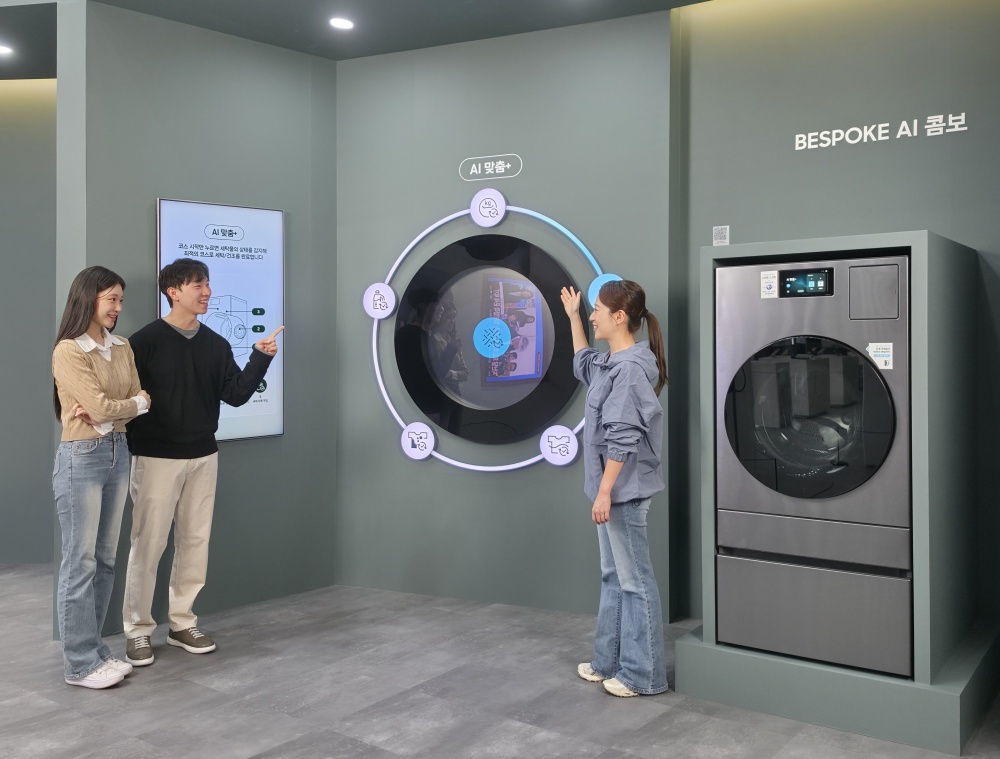
In Samsung's announcement, AI Food Manager uses a refrigerator's internal camera to recognize and manage food. AI Wash+ in the Bespoke AI Combo senses the load and sets washing intensity and drying temperature. Vision AI Companion on a TV answers questions and provides information about content. They all carry the AI label, but their jobs range from camera recognition and sensor control to conversational services.
Comparing names alone hides those differences. Food recognition may save time in a household that regularly checks what is in the refrigerator. Automatic sensing can be more useful for someone who often hesitates over laundry cycles. If a household rarely uses the refrigerator screen or already sorts every load by fabric, capacity, installation space, energy use and basic performance may matter more than the AI feature.
 LG Electronics Newsroom
LG's announcement presents a broader form of connection than one appliance's automatic setting. Its LG ThinQ ON AI home hub links a modular home with a vehicle, including examples such as preheating an oven in the vehicle from home or checking home appliances from the vehicle. Those connected functions add conditions involving accounts, networks, apps and compatible devices. A specification sheet for one appliance may not reveal the full set of requirements.
Ask what remains when the internet goes down
When examining an AI feature, separate the work done inside the appliance from work that passes through an account, app or cloud service. Product manuals and support terms should explain whether basic cooling and washing still work with power alone, whether only remote controls and recommendations stop, and which menus disappear after signing out of the manufacturer's account. The words AI supported do not define that boundary.
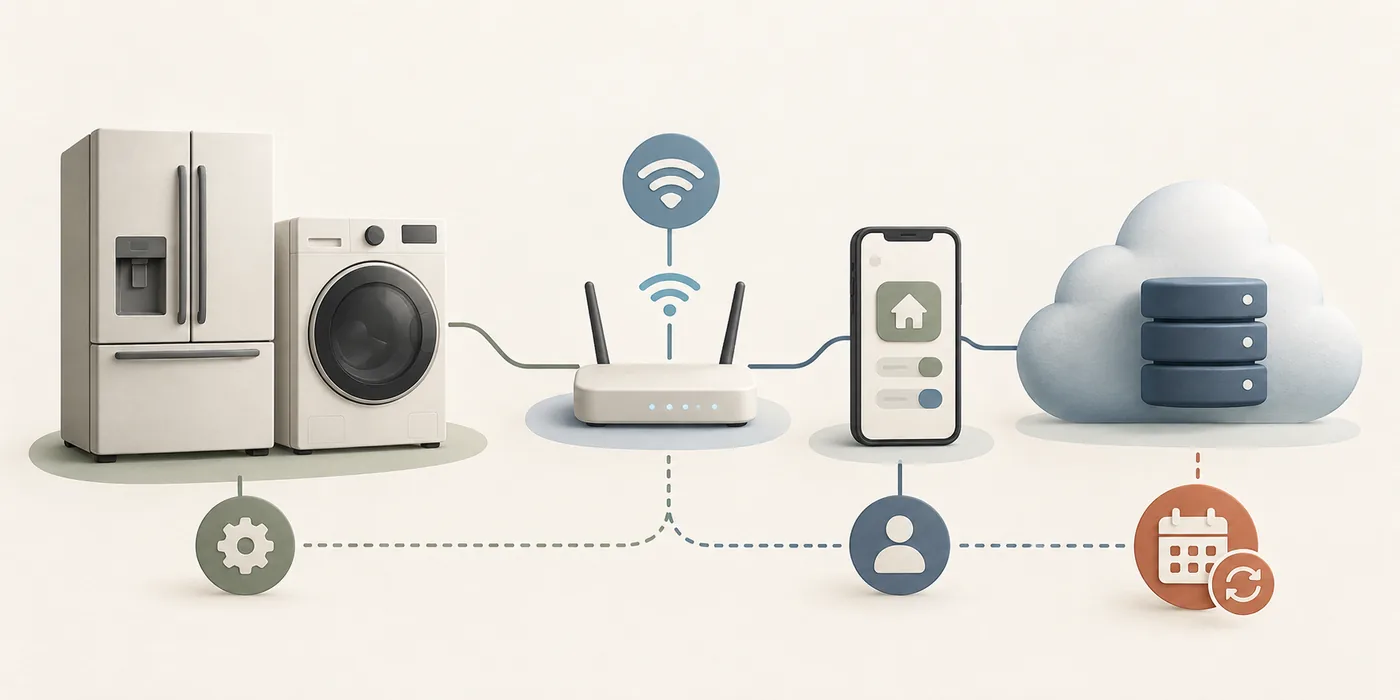
Questions that remove one connection at a time are often more useful than a polished demonstration of an automatic cycle. Ask what happens without Wi-Fi, after changing phones, when family members use different operating systems, or after the app service changes. If voice, video or food data is collected, ask where it is stored and how to delete it. When the answer is unclear, review the manual and privacy notice before buying.
The value of an AI appliance appears in whether it removes one repeated household task, rather than in the number of features it lists.
A subscription adds conditions beyond the monthly price
At KES 2026, Samsung introduced Samsung AI Subscription with delivery, installation and care services, while LG's Subscription & Care area included products such as an ice-making water purifier and WashCombo. A subscription can spread the initial cost and include ongoing care. Looking only at the monthly payment, however, can obscure the total cost and contract terms.
A food-recognition refrigerator should fit the household routine
Samsung's Bespoke AI Family Hub four-door 864-liter RM90H91B1W includes AI Food Manager and a large display. It is a useful reference for following a KES food-recognition feature through to a retail model's specifications and installation conditions. A household that rarely records food or uses a refrigerator screen may instead place more weight on capacity and cooling design within the same budget.
Two separate questions help with this model: what the refrigerator can recognize, and whether anyone in the household will review that record. Recognition has limits and some entries may need manual correction. If the screen and app will rarely be used, consider how much of the premium goes toward features that will remain idle rather than the basic refrigeration job.
For a washer-dryer, installation and drying capacity come first
LG's TROMM AI Objet Collection WashCombo FC2521SX6C has 25-kilogram washing and 21-kilogram drying capacities. Its official description says it senses the load's weight, fabric and soil level to adjust washing motion, detergent amount and rinse count. The purpose is clear for a household that struggles to choose a cycle or wants to stop moving laundry into a separate dryer.
An all-in-one appliance removes the transfer step, but its washing and drying capacities are not identical. Check whether a maximum wash load can also be dried at once, whether there is room to remove the filter, and whether automatic cycles suit the fabrics washed most often. If those conditions do not fit, splitting loads and clearing space around the appliance may overshadow the sensing feature.
Five demonstrations can make the decision clearer
If a store cannot demonstrate all five, the manual and contract can provide the answers. The search reveals which functions end inside the appliance and which depend on an account or continuing service. The same AI appliance can feel very different depending on household size, housing, network conditions and domestic routines.
My own first question would be how many times a week I would use the feature, rather than how many AI functions the appliance has. An added cost may be reasonable when basic operation survives an internet outage, ending a subscription does not sharply reduce the product's usefulness, and automation clearly removes one repeated chore. If no such scene comes to mind, a model that fits the available space, capacity, efficiency and repair conditions is likely to remain useful for longer.
Sources reviewed
The article was checked against the sources below. Image context and credits appear in each caption.