
A higher number on a rate table can create urgency. A saver may want to move immediately, while a borrower may want to refinance. But the rate gap alone can lead to a loss: forfeited interest on an early-withdrawn deposit and switching costs on a loan can absorb the apparent gain.
Bank of Korea data released on September 30 show that, for August 2026, the average rate on newly handled savings deposits was 3.21% and the average lending rate was 4.40%. These figures are a starting point for reading the market, not a personal offer. The decision must be based on the numbers in your own contract.
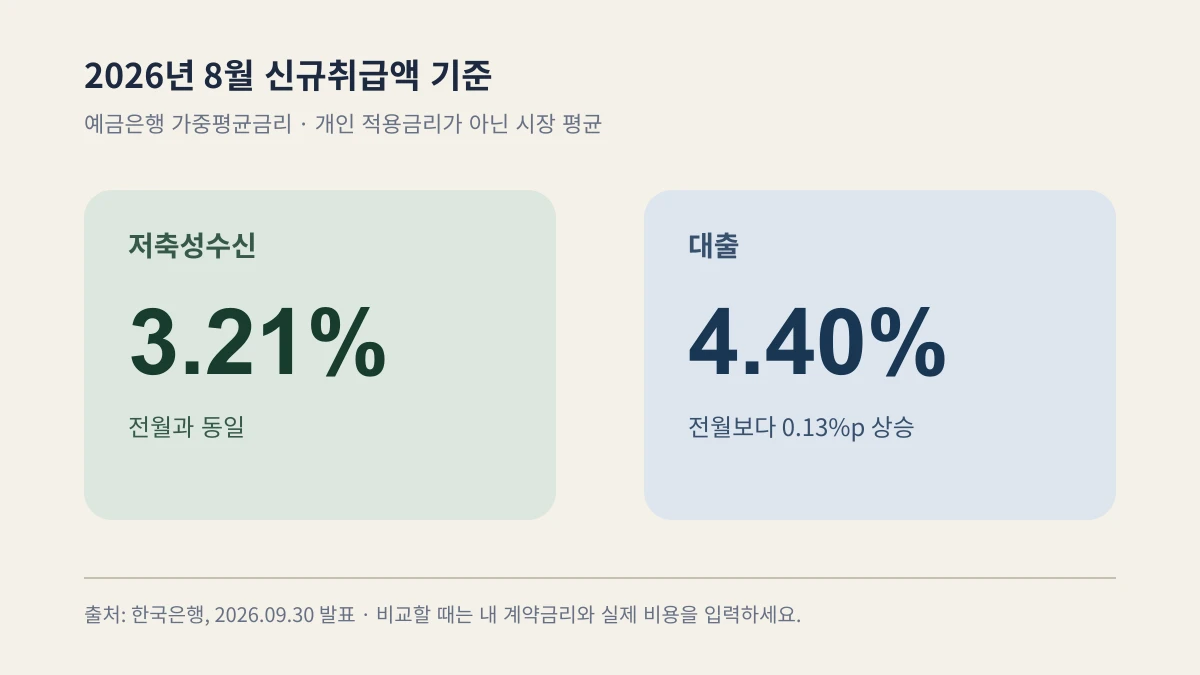
The distance between the 1.19-point gap and your cost
The gap between 3.21% and 4.40% is 1.19 percentage points. It cannot simply be treated as bank profit or household loss. The two averages combine products with different maturities, risks and fixed or variable structures. On an outstanding-balance basis, the total deposit rate was 2.20% and the total lending rate was 4.40% in the same month. New customers and existing contract holders can therefore experience different rates.
| Measure | Rate | Monthly change | How to use it |
|---|---|---|---|
| New savings deposits | 3.21% | Unchanged | Market reference for a new deposit |
| New loans | 4.40% | +0.13 pp | Market reference for a new loan |
| Outstanding deposits | 2.20% | +0.05 pp | Broad average across existing deposits |
| Outstanding loans | 4.40% | +0.03 pp | Broad average across existing loans |
For deposits, compare what remains after tax
Assume KRW 50 million is deposited for one year. Under the ordinary 15.4% withholding assumption and simple interest, 3.21% produces KRW 1,357,830 after tax. At 3.50%, the result is KRW 1,480,500. The 0.29-point headline difference becomes KRW 122,670 in additional take-home interest. Tax-advantaged accounts and comprehensive financial-income taxation can change the result.
| Annual rate | Gross interest | Tax at 15.4% | Net interest |
|---|---|---|---|
| 3.21% | KRW 1,605,000 | KRW 247,170 | KRW 1,357,830 |
| 3.50% | KRW 1,750,000 | KRW 269,500 | KRW 1,480,500 |
| Difference | KRW 145,000 | KRW 22,330 | KRW 122,670 |
That comparison assumes both deposits start today and remain for one year. Moving an existing deposit requires a different calculation. The relevant comparison is between the early-withdrawal payout under the old contract and after-tax interest from holding the new deposit only for the remaining period. If forfeited interest exceeds KRW 122,670 under this example, switching does not pay.
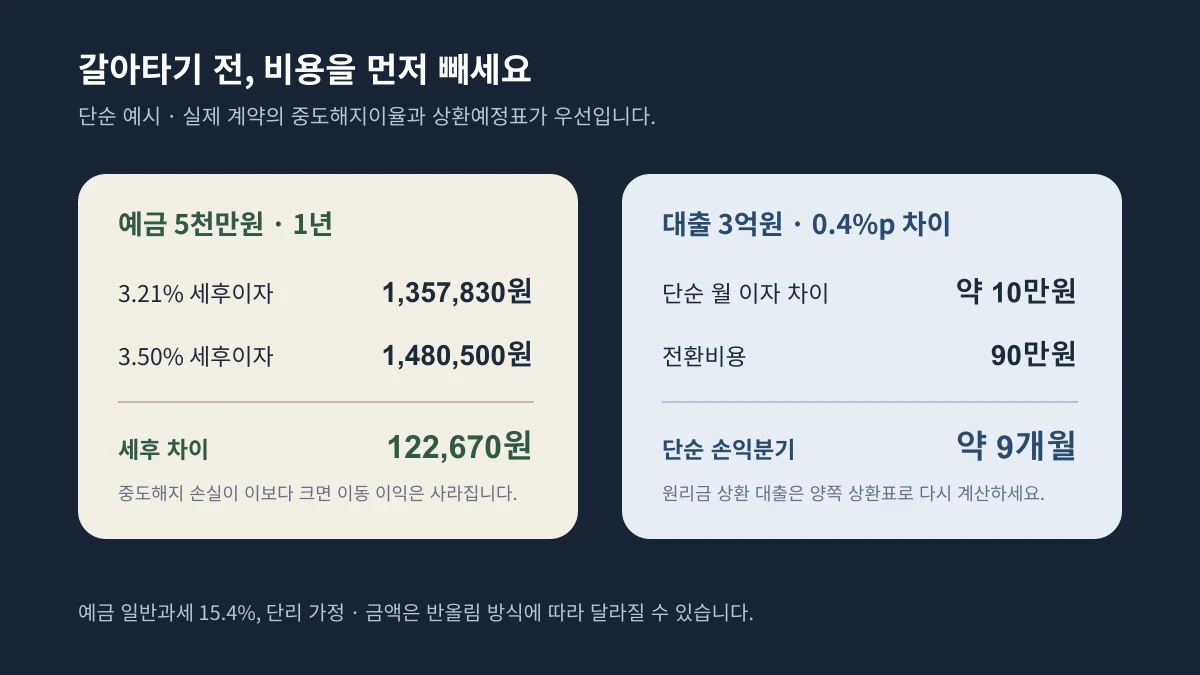
Four numbers to record before moving a deposit
Subtract the value forfeited by moving today from the new product's after-tax maturity amount. A quick simple-interest estimate is principal × annual rate × holding days ÷ 365 × (1 - 0.154), but the institution's day-count and compounding method prevail. Using the early-withdrawal estimate shown in the bank's app is safer.
For loans, focus on when costs are recovered
Suppose a KRW 300 million balance can be refinanced at a rate 0.4 percentage points lower. If the balance were constant, the simple interest difference would be KRW 1.2 million a year, or about KRW 100,000 a month. If the prepayment charge and all other switching costs total KRW 900,000, the simple break-even point is about nine months.
| Input | Example | Result |
|---|---|---|
| Remaining principal | KRW 300 million | Compare the same balance |
| Rate difference | 0.4 pp | Simple annual difference of KRW 1.2 million |
| Simple monthly saving | About KRW 100,000 | KRW 1.2 million ÷ 12 |
| Switching costs | KRW 900,000 | Prepayment charge plus other costs |
| Simple break-even | About nine months | KRW 900,000 ÷ KRW 100,000 |
In practice, a loan balance falls as it is repaid. Equal-payment and equal-principal schedules also produce different interest paths. A lower monthly payment alone is not a sufficient basis for comparison. Repayment schedules for both loans need the same repayment method, remaining term and grace period so that total interest and costs can be compared on equal terms. Extending the term can lower the immediate payment while increasing total interest.

The key question is not how far the rate fell, but when the costs are recovered and how much is saved afterward.
Fixed and variable rates in the household plan
A variable rate can start lower and later change. A fixed rate makes cash flow more predictable for a set period, but its level and fixed-rate period both matter. Neither is always better. Plans to move or sell, the chance of early repayment and possible income changes are all comparison variables.
A ten-minute rate comparison
First, use the Bank of Korea average only as a market reference. Second, find candidates through the Financial Supervisory Service's Financial Products at a Glance service. Third, record the current deposit's early-withdrawal estimate and the new deposit's after-tax maturity amount. Fourth, obtain current and proposed repayment schedules plus every switching cost for a loan. Finally, check whether break-even arrives before the period you expect to hold the contract.
There is no need to change a contract on the day a rate is announced. For a deposit, find when additional after-tax interest minus the early-withdrawal loss turns positive. For a loan, find when cumulative savings minus switching costs turns positive. If the result is close, waiting until maturity or until a fee expires belongs in the same comparison.
This article provides general information based on official sources checked on October 19, 2026. The calculations assume simple interest and ordinary withholding. Individual credit, taxes, promotional conditions and institutional calculation methods can change the result. Before a contract changes, the actual payout figures and repayment schedules provided by the financial institution are the final basis.
Sources reviewed
The article was checked against the sources below. Image context and credits appear in each caption.