
An announcement that Korea's auto-insurance standard for future treatment costs changes from October 25, 2026 can easily sound as if every accident after that date loses its settlement payment. October 25, however, is not a universal cutoff based only on the accident or settlement date. The new standard also considers when the policy covering the accident was concluded and when its insurance period began.
A second date, September 10, marks the start of the review process for minor-injury patients seeking treatment beyond eight weeks. Both changes concern auto-insurance medical costs, but their tests and affected groups differ. This article separates them using guidance from Korea's financial authorities, the Ministry of Land, Infrastructure and Transport, and an insurer, checked on October 15, 2026. An individual payment and the need for treatment can still depend on the applicable policy terms, injury grade and medical records.
September 10 uses the accident date; October 25 uses the policy commencement date
The long-term-treatment review applies to accidents occurring on or after September 10, 2026. Guidance on the future-treatment-cost change says it applies to policies concluded under the revised terms on or after September 10 whose insurance periods begin on or after October 25. Using only the accident date for both changes can produce the wrong answer.
| Change | Date test | Who it concerns | What to check |
|---|---|---|---|
| Review beyond eight weeks | Accidents on or after Sept. 10, 2026 | Minor-injury grades 12–14 involving sprains or simple contusions | Accident date, injury grade and documents due within seven weeks |
| Future-treatment-cost standard | Policy concluded on or after Sept. 10 with its insurance period starting on or after Oct. 25 | Different standards for grades 1–11 and 12–14 | Applicable terms and commencement date for the policy covering the accident |
Consider a hypothetical Policy A whose insurance period began on June 1, 2026 and Policy B whose period began on November 1. If Policy B was concluded under the revised terms on or after September 10, it may fall under the new future-treatment-cost standard. Policy A should not be assumed to switch automatically merely because the accident occurred after October 25. In a real claim, do not rely only on the injured person's own renewal date; ask the handling insurer which policy terms and commencement date cover the accident.
Future treatment costs and incurred medical costs are different
Future treatment costs are an estimate of treatment expected after settlement. Under the revised standard, they are paid to seriously injured patients in grades 1–11 when a future need for treatment is medically and objectively recognized. For minor-injury grades 12–14, the standard shifts from a uniform future-treatment-cost payment at settlement to coverage of medical costs actually incurred until treatment is completed.
This change does not abolish every component of an auto-accident settlement. Other heads of loss, including consolation damages and lost earnings, are assessed under their own requirements, evidence, fault allocation and applicable policy terms. Claims that minor-injury patients will receive no settlement payment at all, or that medical costs stop on October 25, extend beyond the actual rule.
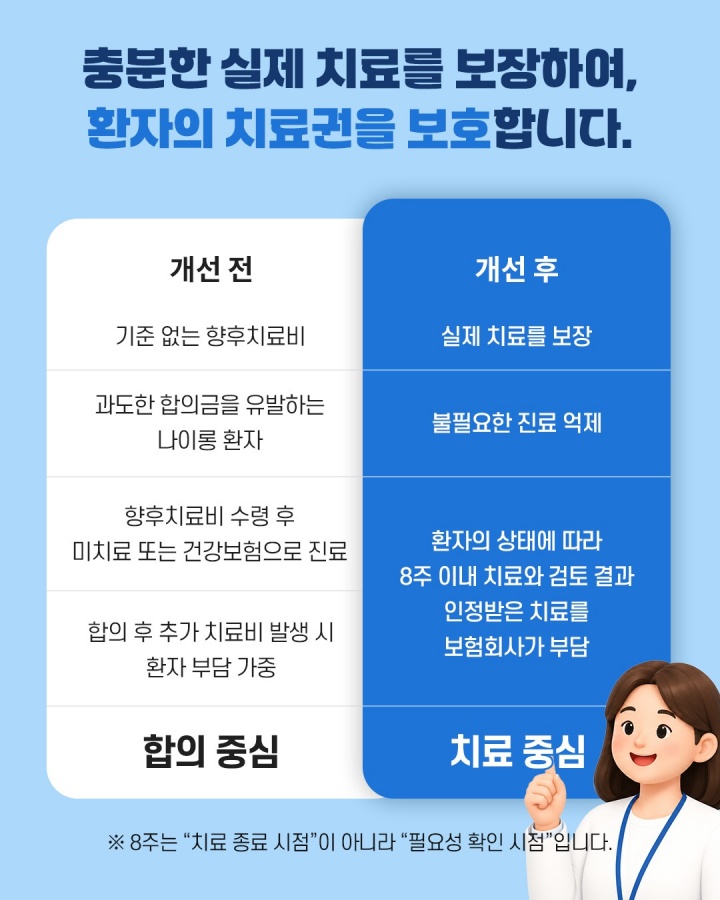 Korea Policy Briefing / Ministry of Land, Infrastructure and Transport
For treatment beyond eight weeks, submit documents within seven weeks
For an accident on or after September 10, 2026, a patient in injury grades 12–14 who has a sprain or simple contusion and needs treatment beyond eight weeks is subject to review by a medical professional at the Korea Automobile Damage Compensation Promotion Agency. Eight weeks is not an automatic end to treatment. The process checks the reason further treatment is needed.
According to the Financial Supervisory Service, the patient must submit a medical certificate, a copy of the medical record and a consent form for the collection and use of personal information to the insurer within seven weeks of the accident. If imaging has already been performed, the patient also submits the corresponding imaging CD; the process does not require a new scan solely for the review. After receiving the materials, the insurer promptly asks the Korea Automobile Damage Compensation Promotion Agency to conduct the review. The agency plans to complete it and notify the patient within seven days from the review request date, which the guidance identifies as the materials-submission date. Confirm the exact documents and deadline for the particular accident with the claims representative.
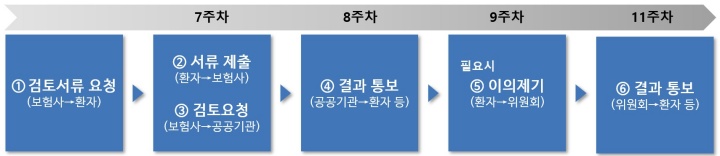 Korea Policy Briefing / Ministry of Land, Infrastructure and Transport
The insurer or mutual-aid association bears the agency's review fee and other review costs. The patient first pays the hospital for required materials such as the medical certificate, copy of the medical record and any existing imaging CD, then claims those issuance costs from the insurer; costs for materials added at the patient's discretion remain with the patient. If the patient applied within seven weeks but the review is delayed beyond week eight, the insurer or mutual-aid association guarantees payment for medical costs incurred until the review ends. That condition should not be extended to medical costs during an appeal. The review is limited to minor-injury patients with sprains or contusions, while pregnant patients and children aged seven or younger may continue treatment without it. A patient who objects may apply for another review by a government committee.
Three questions can identify the applicable rule
When the applicable standard is unclear, ask about the policy terms before asking about a settlement amount. Korea's Auto Insurance Comprehensive Portal provides official information on the system and disputes, but an individual claim must be assessed through the handling insurer and the medical record.
This article provides general information and does not determine an individual settlement amount or the medical appropriateness of treatment. Results can vary with fault, proof of earnings, treatment records and policy conditions. If a filing deadline is near or the insurer's guidance does not match the course of treatment, request written guidance from the claims representative and consider professional advice where needed.
The purpose of keeping the two dates separate is not to rush a settlement. September 10 is the starting point for checking the accident-date test for long-term treatment review. October 25 is the starting point for checking the commencement date and terms of the policy covering the accident. In bigbread's view, reviewing the applicable policy, injury grade and evidence of treatment need in that order is more accurate than reducing the change to a claim that settlement payments have disappeared.
Sources reviewed
The article was checked against the sources below. Image context and credits appear in each caption.
- Financial Supervisory Service, Changes to Auto-insurance Medical-cost Procedures From Sept. 10, 2026 (Sept. 2, 2026; original PDF pp. 2, 4 and 5–8)
- Korea Policy Briefing / Ministry of Land, Infrastructure and Transport, review for minor-injury treatment beyond eight weeks (Aug. 4, 2026)
- KDI Economic Information and Education Center, changes to auto-insurance medical-cost procedures (Sept. 3, 2026)
3 more sources
- DB Insurance, consumer notice on auto-insurance changes citing the Financial Supervisory Service (Sept. 10, 2026)
- Korean Law Information Center, Enforcement Rules on Insurance Business Supervision [effective Sept. 10, 2026]
- Korea Auto Insurance Comprehensive Portal, auto-insurance information and dispute guidance