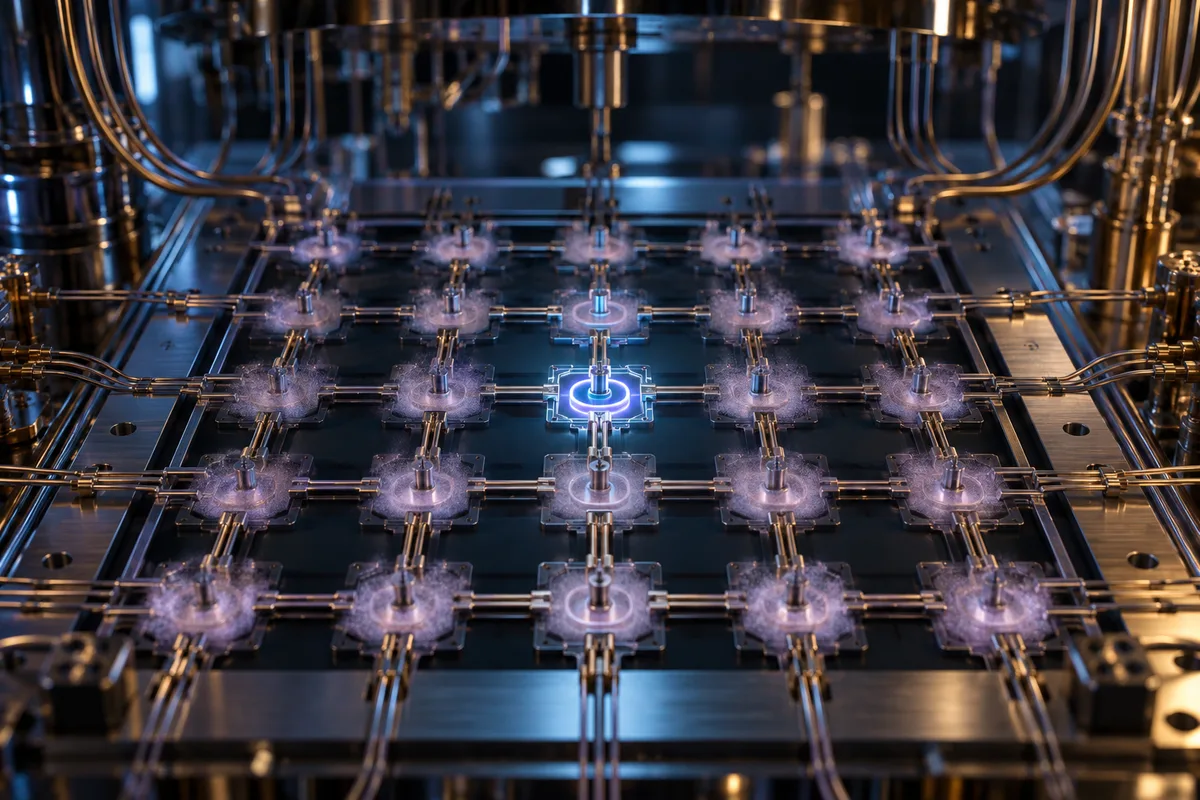
On October 15, 2026, Google Quantum AI announced an experimental demonstration of magic state cultivation on its Willow processor. The roughly 40-fold figure is striking, but it does not mean that the entire quantum computer became 40 times faster or cheaper. It describes a reduction in the preparation error of T states needed for fault-tolerant computation, conditioned on experimental shots that passed the checks.
The key to reading the result is to keep different denominators separate. The 40-fold figure is the reduction in state-preparation error, 0.9999(1) is the logical fidelity of the retained T state, and about 8% is the share of attempts accepted in the evaluation circuit. Combining the three into one claim suggests an almost perfect quantum computer, which is not what the paper reports.
 XenoSpectrum
The Clifford barrier and consumable T states
Clifford gates are comparatively tractable to perform under surface-code error correction, but they are not sufficient for universal quantum computation. A non-Clifford T gate must be added, and common fault-tolerant architectures implement it by injecting a previously prepared magic state. The resource is consumed on use, so supplying clean states reliably becomes a bottleneck as the computation grows.
Conventional magic state distillation feeds several imperfect states into a large circuit to obtain fewer, cleaner ones. Cultivation shifts the approach. It creates a candidate inside a small error-correcting code, checks for error signatures over several rounds, and moves only a passing state into a larger code. Post-selection—discarding a bad candidate early rather than repairing it—is central.
 Phys.org
From injection to cultivation
The experiment first injected a physical T state into a distance-3 color code. The error rate at this stage was 4.4(2)×10⁻³. The team used flag qubits and stabilizer measurements to watch error propagation and rejected shots with anomalous signals. Further checks followed as code distance was expanded across space and time.
According to the Science paper record and the experimental paper preprint, the error of selected states fell by about a factor of 40 from injection, and logical fidelity was estimated at 0.9999(1). The 1 in parentheses denotes statistical uncertainty in the final digit. The result was checked against a classical simulation of a 54-qubit circuit, but it is not the success probability of a complete algorithm or the cumulative error rate of a long computation.
| Figure | Measured object | Supported reading | Unsupported reading |
|---|---|---|---|
| About 40× | Post-cultivation error versus injection | A large reduction in selected T-state preparation error | A 40× improvement in total computer speed or cost |
| 0.9999(1) | Retained logical T state | About 99.99% fidelity under the measurement model | A 99.99% success rate for the full algorithm |
| About 8% | Accepted shots in the evaluation circuit | Most candidates were discarded by checks | An 8% utilization rate for the processor |
| 54 qubits | Circuit used for classical verification | Comparison of experimental and simulated distributions | A computation with 54 logical qubits |
Measuring a very low error rate
Directly resolving an error rate near 10⁻⁴ with straightforward sampling can require roughly 10⁸ measurements. The researchers used Clifford kickback tomography to reduce the verification burden to around 10⁴ measurements. The method combines a T state with Clifford operations to turn it into an observable signal, then infers the state from measurements along multiple axes.
Fewer samples make interpretation more delicate. In early tests, phase drift across measurement directions interacted with post-selection, so retained data from different conditions could be combined as though they described one state. Linear inversion could then produce unphysical estimates outside the Bloch sphere, including fidelity above one. The researchers addressed this with a Bayesian model constrained to physical states. The 0.9999(1) figure is therefore an estimate produced by a circuit model and statistical inference, not a number read directly from one measurement count.
From color code to surface code
A color code offers advantages for cultivation, while the surface-code ecosystem is more mature for large-scale storage and operations. The team grafted the state prepared in a distance-3 color code into a distance-5 surface-code patch. The process transfers logical information by rearranging the boundary between different stabilizer structures; it is not a simple copy between physical qubits.
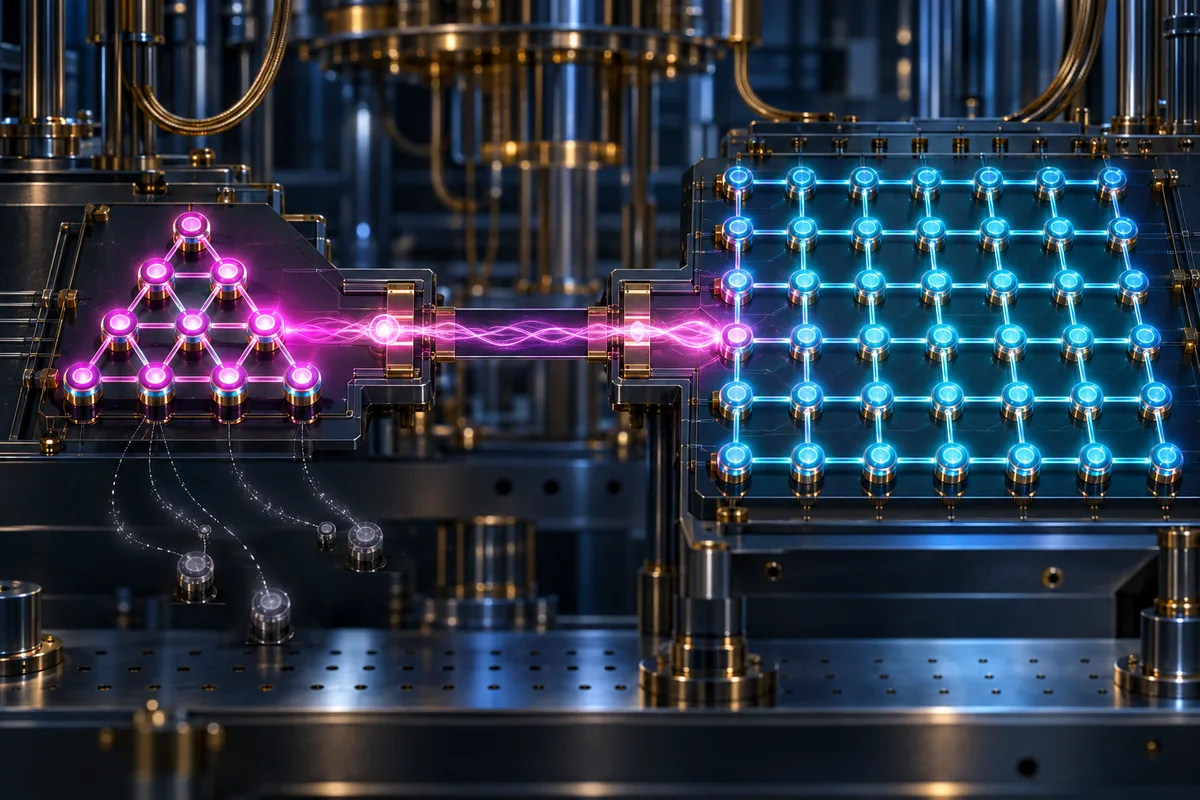
The graft matters because it joins the advantages of two codes in one pipeline. Yet the paper reports that idle errors accumulated while the state sat in the surface code, nearly erasing the cultivation gain by the stage at which the T state would be used. Even after successful preparation, a delay before the next operation lets errors rebuild during storage.
Three remaining bottlenecks
A follow-up practical-cost analysis argues that removing the final destructive measurement and preserving the state for actual computation may require a larger code and a longer escape stage. This does not refute the experiment. It adds cost categories that must be counted when converting a device demonstration into factory throughput.
The experiment connected encoding, error detection, fast classical control, code grafting and logical measurement in one hardware workflow. That integration should be considered alongside the headline 99.99% figure. But the paper did not execute a real-time T gate using an accepted state or demonstrate a factory continuously delivering many T states.
This experiment did not complete a fault-tolerant quantum computer. It implemented on real hardware the process of preparing a magic state and transferring it into a larger code. The next milestone is not merely another fidelity record. It is repeated delivery of usable T gates while reducing acceptance cost, storage error and classical-control latency together. Future announcements should be judged first by total cost per delivered state and sustained throughput, not a single peak number.
Sources reviewed
The article was checked against the sources below. Image context and credits appear in each caption.