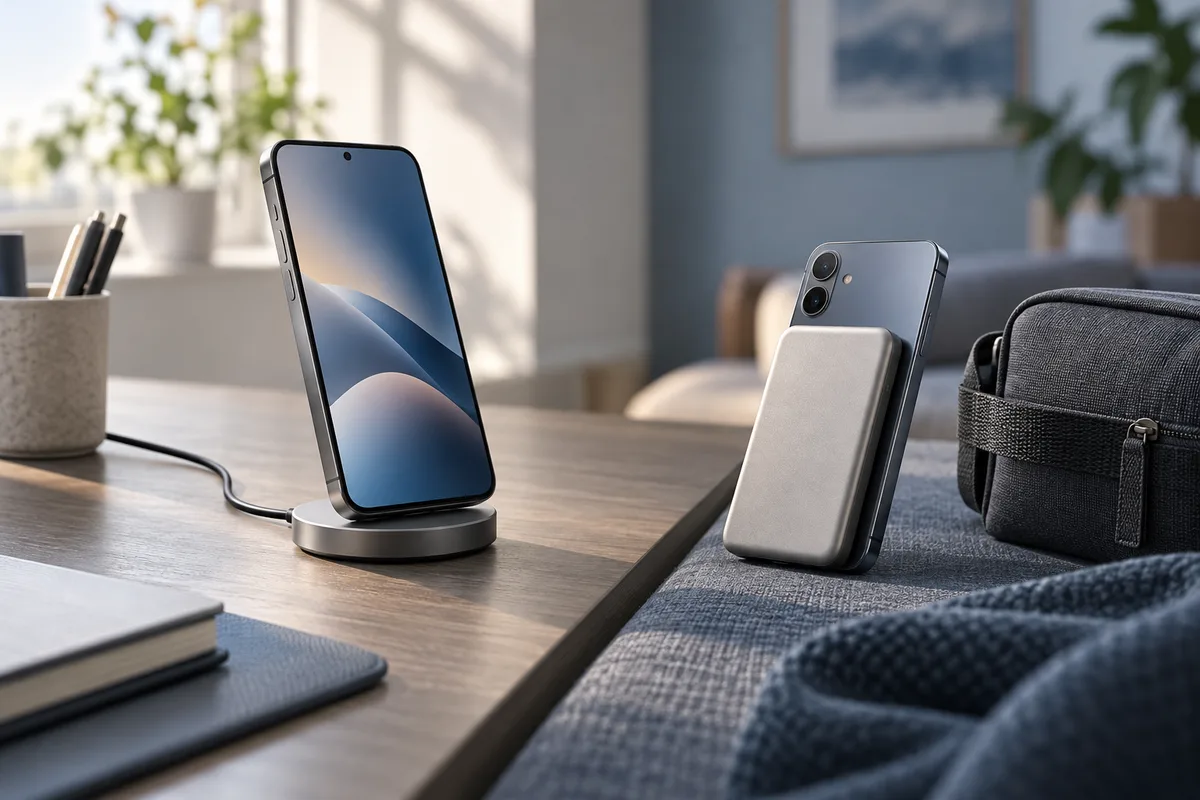
The first numbers you notice on Qi2 products are 25W and 15W. It is tempting to treat 25W as the automatically superior choice, but a fixed charger and a power bank use power differently. One draws power from the wall; the other carries stored energy and portions it out on the move.
Peak output alone does not determine which product is better. Actual speed depends on the phone's receiving limit, adapter, case, and temperature, while desk and mobile use call for different products. Fixed 25W charging has an advantage for short charging windows, while portable 15W charging keeps a phone running away from an outlet.
 Wireless Power Consortium
Why the same Qi2 name covers different outputs
The Wireless Power Consortium calls Qi v2.2.1 Qi2 25W. It raises the output ceiling while building on Qi2 magnetic alignment and interoperability. The Qi2 label alone, however, does not mean every product delivers 25W. Existing 15W products are also part of Qi2.
The 25W figure is not a specification of the charger alone. The phone's receiving limit, operating system, magnetic alignment, case, power adapter, and ambient temperature all have to cooperate. If one condition is missing, the system may step down to a lower level for safety. A package maximum is not the same as a continuously sustained figure on your desk.
Four conditions that determine 25W charging
First, the phone must accept the output. Second, the coil centers must align; some Android phones need a Qi2 Ready magnetic case. Third, the charger needs the specified USB-C PD adapter. Fourth, the phone and charger may lower output when temperatures rise.
If a 25W charger feels slow, the cause can be narrowed down through the phone model, case, adapter, and temperature. Card-wallet and thick protective cases can increase coil distance and disturb alignment.
How fixed and portable designs differ
A fixed charger continuously draws wall power, which makes higher output easier to sustain. A power bank must move stored cell energy through voltage-conversion circuitry and a wireless coil. It has to balance heat, weight, and runtime inside a slim enclosure, so a higher output number is not the only goal.
| Factor | Fixed Qi2 25W | Qi2 15W 10,000mAh |
|---|---|---|
| Primary setting | Desk or bedside | Commute, business trip, travel |
| Power source | Wall adapter | Internal battery |
| Strength | Fast initial charging under compatible conditions | Charging without an outlet |
| Check | Phone limit, adapter, heat | Weight, usable capacity, wireless loss |
| Alternative | 15W can suffice for long sessions | Use USB-C when speed matters |
The 10,000mAh figure is the nominal capacity of the internal cells. Voltage conversion and wireless transmission losses mean less reaches the phone. Anker states that the A1664 can provide about 5,500 to 6,500mAh of usable capacity. That is why dividing 10,000 by the phone battery size overstates the number of full charges.
Belkin WIA014 for the desk
 Belkin
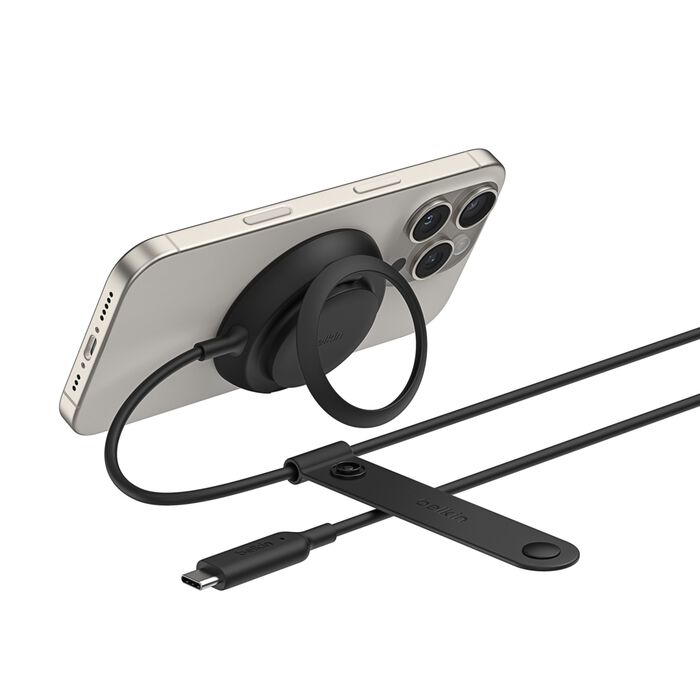
The Belkin WIA014 suits a desk or bedside table where an outlet is available and charging time may be short. Its official specifications list Qi2 25W, a 2m USB-C cable, a kickstand, and a finger loop. Its flat puck-like body can also hold the phone upright for viewing.
Its strongest argument is not the 25W label by itself but a clearly defined use case. When you have only a short window before leaving and the phone and power source are compatible, the higher ceiling is easier to exploit.
If you charge overnight or your phone tops out at 15W wirelessly, the extra output may not be noticeable. The complete setup, including the adapter already in use, determines actual speed.
Anker A1664 for time away from an outlet
 Anker
The Anker A1664 is designed to bridge time without an outlet. Its official specifications list 10,000mAh, Qi2 wireless output up to 15W, and USB-C input/output up to 30W. You can attach it wirelessly for convenience and switch to a cable when speed matters.
Portability adds weight. The official weight is 215.9g, which is added to the phone in your hand. Heavy use such as gaming or video recording while charging can raise temperature and reduce output.
Choosing mobile convenience also means accounting for the bulk and weight of a 10,000mAh battery. When a lighter battery matters more, portability becomes a more useful comparison than capacity alone.
One-line choices by use case
Five checks before payment
Fixed 25W and portable 15W products are not simply higher and lower tiers. The former saves time; the latter removes location constraints. Using charging location and duration as the starting point makes it easier to avoid excess output or insufficient capacity.
Sources reviewed
The article was checked against the sources below. Image context and credits appear in each caption.
This article contains affiliate links, and the publisher may receive a commission from qualifying purchases.