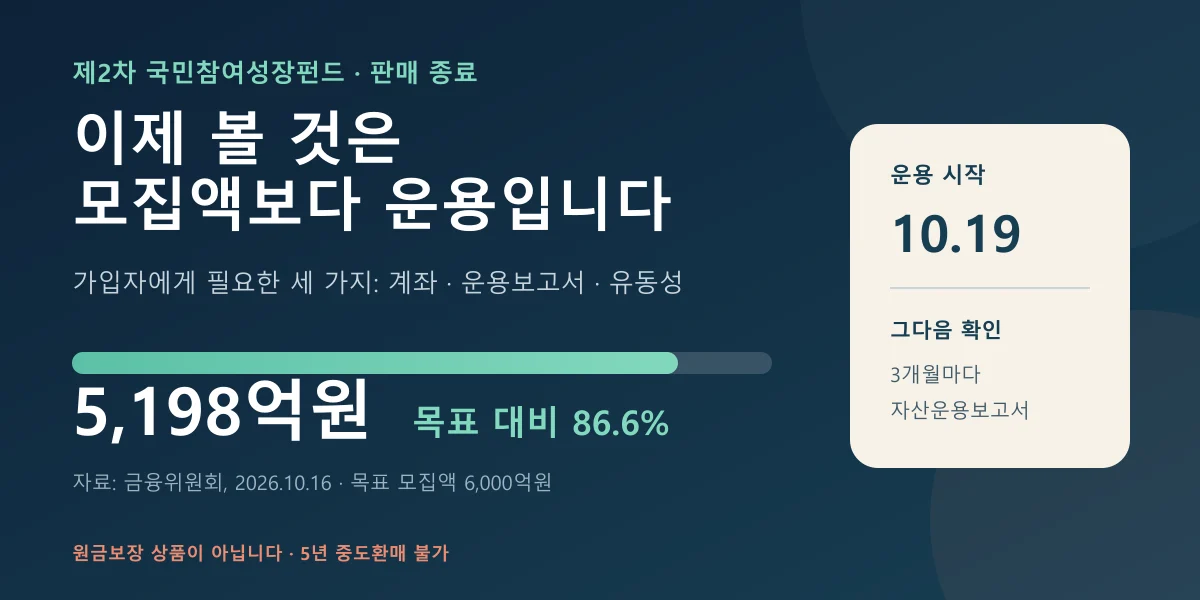
Subscriptions for Korea's second public-participation growth fund have closed. The Financial Services Commission said on October 16 that the final amount raised was KRW 519.8 billion, or 86.6% of the KRW 600 billion target. Banks sold KRW 170.3 billion and securities firms KRW 334.5 billion. More useful than labeling that result a success or a disappointment is a practical question for investors: when does the money begin to be invested, and what should they check next?
The three public feeder funds were established on October 16, and actual investment through ten underlying funds is scheduled to begin on October 19. The return shown in an account immediately after the sale is therefore not a verdict on the strategy. This is the time to confirm the subscription and reread the exit and loss structure before the first asset-management report arrives.
86.6% subscribed, no signal on returns
The KRW 519.8 billion includes KRW 15 billion invested from the own capital of the three public-fund managers. Online sales accounted for 83.7% and the lower-income allocation for 26.5%. Those figures describe who subscribed and through which channels; they do not forecast the value of portfolio companies or future performance.
| Item | Official figure | How to read it |
|---|---|---|
| Final amount raised | KRW 519.8 billion | Includes KRW 15 billion of managers' own capital |
| Share of target | 86.6% | Does not indicate future return or loss |
| Feeder funds established | October 16 | The reference date when the funds were created |
| Underlying investment | Scheduled from October 19 | Marks the start of deployment, not necessarily full investment on day one |
| Detailed monitoring | Every three months after establishment | Use asset-management reports to review holdings, costs and risk |
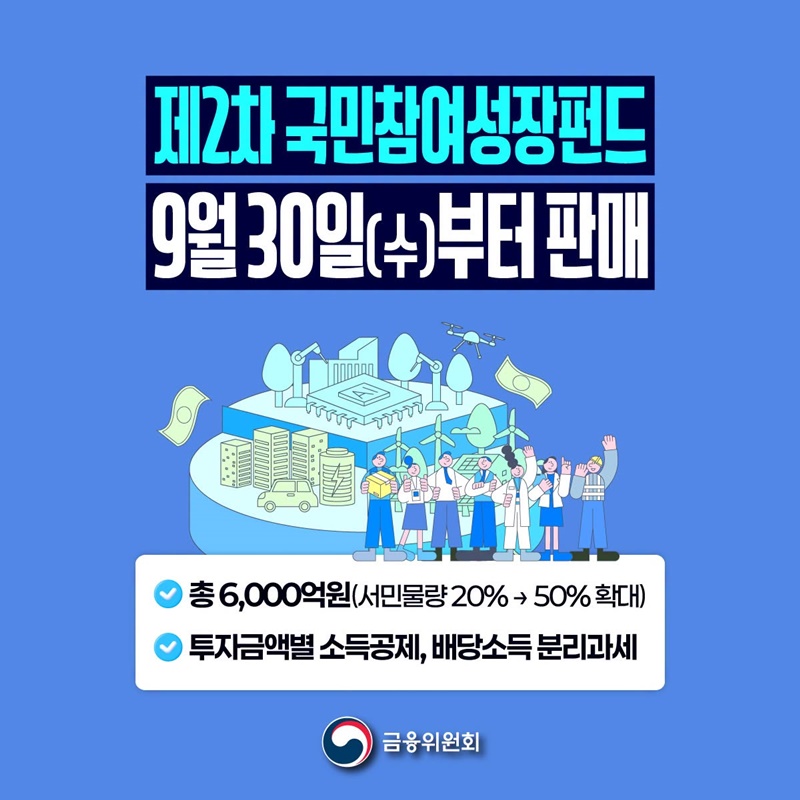 Korea Policy Briefing / Financial Services Commission
Junior capital: loss cushion, not principal protection
The phrase most likely to be misunderstood is that the government absorbs the first 20% of losses. The KRW 600 billion raised from the public is senior capital, while KRW 120 billion of fiscal capital and seed investments by the underlying fund managers are junior. Losses in an underlying fund reduce that junior capital first.
But KRW 120 billion equals 20% of the public capital, not 20% of the entire underlying-fund pool. The FSC said the combined first-loss share of fiscal and manager seed capital varies from 17.5% to 20.8% by underlying fund. A larger loss can reach the public investors' senior capital. The junior tranche is a cushion that takes the first impact, not a guarantee that repays principal.
Junior capital taking the first loss is not the same as an investor's principal being guaranteed.
Five-year lockup and exchange sale: two different exits
This is a five-year closed-end fund. An investor cannot request an ordinary early redemption from the distributor when cash is needed. Units may be sold to another investor after exchange listing, but a buyer may not be available and the market price may be below net asset value. Listing should not be read as a promise of immediate liquidity.
The three-year tax rule also differs from the five-year fund term. If an investor using the designated tax account transfers the units within three years, the tax savings from the income deduction and separate taxation may be clawed back unless a statutory exception applies. Passing three years does not open ordinary redemption. Before maturity, an exchange sale still carries market-price and liquidity risk.

Account now, management report every three months
First, use the distributor's app or branch to confirm the subscribed amount, account type, fund name and processing status. Keep the subscription confirmation and prospectus because tax treatment differs between the designated and ordinary accounts. An initial account return can move with deployment speed, valuation dates and expense recognition, so it cannot be extrapolated into a five-year result.
The FSC says an asset-management report will be provided every three months after establishment. When the first report arrives, look beyond the return. Check what has been bought and in what proportion, how much cash remains undeployed, which expenses have been recognized and whether the key risks have changed from the prospectus.
Monitoring rules before performance forecasts
The start of actual investment on October 19 does not mean all capital must be deployed on the first day. Building and valuing a long-term portfolio that includes unlisted companies and mezzanine securities can take time. Rather than changing conclusions with each short-term move, decide now what to inspect when the quarterly report arrives.
The sale is over, but investor monitoring is beginning. First, confirm the subscription in the account. Second, do not mistake the junior cushion for principal protection. Third, read the management report every three months and distinguish net asset value from market price after listing. Those steps keep attention on information that matters more to an individual investment than the headline figure of KRW 519.8 billion.
This article provides general information based on official sources checked on October 17, 2026. It is not individualized investment or tax advice. Confirm account-specific terms and actual tax treatment with the distributor or a qualified tax professional.
Sources reviewed
The article was checked against the sources below. Image context and credits appear in each caption.
- Financial Services Commission, second public growth fund closes after raising KRW 519.8 billion (Oct. 16, 2026)
- Financial Services Commission, investment structure and junior first-loss explanation (May 21, 2026)
- KDI Economic Information and Education Center / FSC, detailed launch guidance (Sept. 23, 2026)